Tuesday, January 25, 2011
Saturday, January 22, 2011
Introduction of Service Discharge Benefit Scheme (SDBS) for Gramin Dak Sevaks
File No. 6-11/2009-P.E.II
Government of India
Ministry of Communications & IT
Department of Posts
(Establishment division)
Dak Bhawan Sansad Marg
New Delhi 110001
Dated 19th January 2011
Chief Postmaster General,
Postmasters General
Subject: Introduction of Service Discharge Benefit Scheme (SDBS) for Gramin Dak Sevaks
Sir/Madam,
I am directed to refer to this office letter of even no. dated 01.09.2010 on the above mentioned subject.
2. In para 3 of the said communication, the detailed course of action was laid down. The most important was obtaining options from the existing Gramin Dak Sevak and also to obtain applications in the prescribed format and so send them to concerned Central Record Keeping Agency of National Security Depository Limited for registration. But, the National Security Depository Limited has brought to notice that the following omissions are noticed in the applications of Gramin Dak Sevak sent to Central Record Keeping Agency for registration.
* 90% of the applications sent are without authorization of Divisional Superintendent (Collection centre) and designation stamp.
* The Date of birth of the Gramin Dak Sevak is found missing or wanting.
* The signature of the Gramin Dak Sevak exceeded the box provided in the application form.
* Complete address of the Gramin Dak Sevak and Postal Index code number are not furnished.
* Despite clear instructions, the beneficiaries have affixed Black and white Photo which cannot be scanned. Only colour Pass Port size photographs has to be affixed for facilitating scanning.
* The Photo affixed is not clear in certain cases, which are thus not scanable
3. This obviously shows, that, the Collection centers have not examined the applications properly and sent to Central Record Keeping Agency without proper verification, attestation, and impression of designation stamp of collection center. This is resulting in delay in launching the scheme.
4. The National Security Depository Limited is requested for returning all such defective applications to respective Collection centers for resubmission of the applications, after attending to omissions pointed out above. Suitable instructions may be issued to all the Divisional heads in this regard.
5. It is requested to accord top priority to this work.
Yours faithfully,
Sd/-
(K. Rameswara Rao)
Asstt. Director General (Estt)
Posting of women employees – Reg. -to avoid posting women employees where there are no basic and essential amenities for women,
No. 137-10/2011-SPB.II
Government of India
Ministry of Communications & IT
Department of Posts
Dak Bhawan, Sansad Marg
New Delhi, Dated the 18th Jan, 2011
To
All Chief Postmasters General
All Postmasters General
All Postal Training Centres
CGM, PLI Directorate, Chanakaya Puri Post Office Complex, New Delhi
Subject: Posting of women employees – Reg.
Sir/Madam,
I am directed to say that during the meeting of the Departmental Council (JCM) held on 27.08.2010 under the Chairpersonship of Secretary (Posts), an item regarding non-posting of women employees where basic amenities are not available was raised by the Staff side. The Staff side has stated that a number of Post Offices/RMS Offices are not having all the basic amenities and women employees are finding it difficult to work in such places. The staff side has, therefore, demanded that women employees should not be posted to such offices before ensuring basic amenities in such places.
2. It was informed to the staff side that Dte has issued instructions vide letter No. 137-12/98-SPB.II, dated 29.04.1998 to all Postal Circles advising them to avoid posting of ladies staff where basic amenities are not available in the office. It was decided in the meeting by the Chairperson that instructions on the subject be reiterated to all Heads of circles for strictly compliance.
3. In the Directorate’s letter No. 137-12/98-SPB.II, dated 29.04.1998, it was inter-alia advised to avoid posting women employees where there are no basic and essential amenities for women, Circles are, therefore, requested to scrupulously follow these instructions before women employees are posted/transferred from one work place to other. It may be ensure that women employee is transferred to an office only after ensuring that basic and essential amenities for women are available there. The Circles are also requested to identify these offices which are lacking basic amenities and take action for providing them immediately.
Yours faithfully,
Sd/-
(Suraj Bhan)
Asstt. Director General (SPN)
Friday, January 14, 2011
Friday, January 7, 2011
Wednesday, January 5, 2011
Stepping up of pay of the promotee senior with direct recruited junior appointed on or after 01.01.2006
No. 1-9/2010-PCC
Government of India
Ministry of Communications & IT
Department of Posts
Pay Commission Cell
Dated – 05.01.2011
To,
All Heads of the Circles
Subject: - Stepping up of pay of the promotee senior with direct recruited junior appointed on or after 01.01.2006
This is regarding stepping of pay of promote senior with reference to direct recruit junior appointed after 01.01.2006.
2. The issue was examined in this office and referred to Ministry of Finance for clarification. Ministry of Finance Department of Expenditure Legal Cell vide U.O. No. 18/28/2010-Legal dated 29.12.2010 has calrified that the stepping up of pay of the promote senior with direct recruited junior appointed on or after 01.01.2006 may be agreed to subject to fulfillment of the following conditions: -
(a) Stepping up of the basic pay of seniors can be claimed only in the case of those cadres which have an element of direct recruitment and in cases where a directly recruited junior is actually drawing more basic pay than the seniors. In such cases, the basic pay of the seniors will be stepped up with reference to the basic pay of the directly recruited junior provided they belong to the same seniority list for all purposes.
Further, government servants cannot claim stepping up of their revised basic pay with reference to entry pay in the revised pay structure for direct recruits appointed on or after 01.01.2006 as laid down in Section II of part A of First Schedule to the CCS (RP) Rules, 2008, if their cadre does not have an element of direct recruitment or in cases where no junior is drawing basic pay higher than them.
Stepping up of pay of the seniors in accordance with the present advice of this Department shall not be applicable in cases where direct recruits have been granted advance increment at the time of recruitment.
3. The issues prevailing in the Circle may be decided as per above clarifications.
Sd/-
(Surender Kumr)
Assistant Director General (GDS/PCC)
Interest bearing advances/Sixth Central Pay Commission recommendation on House Building Advance-enhancement in past cases-regarding
No.I-17011/2(1)/2009-H.III
Government of India
Ministry of Urban Development
(Housing -III section)
Nirman Bhawan, New Delhi.
Dated:- the 14th July, 2010
OFFICE MEMORANDUM
Subject: Interest bearing advances/Sixth Central Pay Commission recommendation on House Building Advance-enhancement in past cases-regarding.
The undersigned is directed to invite attention to this Ministry's O.M. No.I-17011/2(1)/2009-H.III dated 27th November, 2008 on the above subject and to say that it has been decided in consultations with Ministry of Finance to make the afore-said orders applicable with effect from 1st January, 2006. Accordingly, an enhancement of House Building Advance, if applied for, may be granted for an amount equivalent to the difference between the previously sanctioned amount and the new amount determined on the basis of pay in the pay band, in past cases, where HBA was sanctioned on or after 1-1-2006 but before 27-11-2008 subject to complying following conditions:-
(a) The Government servant should not have drawn the entire amount of HBA sanctioned under earlier orders and /or where construction is not completed/full cost towards acquisition of house/flat is yet to be paid.
(b) There will be no deviation from the approved plan of construction on the basis of which the original sanction of House Building Advance was accorded. The revised cost of the original plan can, however, be considered for determining the additional amount, subject to the prescribed maximum limits.
(c) Supplementary Mortgage Deed, Personal Bond and Sureties will be drawn and executed at the expense of the loanee.
(d) The actual entitlement will be restricted to the repaying capacity computed on the basis of the formula laid down in this Ministry's O.M. No.I-17015/16/92-H.III dated 17.10.2000. It should be ensured that the entire amount of advance with interest is recovered before retirement of the Government servant.
(e) Rate of Interest: The rate of interest chargeable in such cases would be as per the slab applicable to the total sanctioned amount i.e. amount already sanctioned on or after 1-1-2006 but before 27.11.2008 plus the enhanced sanction. However, the new rate of interest would be chargeable only on collective amount that would remain outstanding on grant of enhancement so granted. Thus, the amount of HBA that has already been re-paid on old rates will not attract the fresh interest charges.
2. However, the existing limit of maximum admissible amount of Rs.7.50 lakh for the purpose of construction/purchase of new house/flat and Rs.1.80 lakh would remain unchanged. In other words, the sum total of previously sanctioned HBA and the enhancement granted under these orders cannot exceed the aforesaid limits. In any case, not more than one enhancement is admissible to a Govt. employee.
3. The applications for enhanced HBA should be submitted within six months from the date of issue of this order.
4. Ministries/Departments whose branch offices are situated in the far flung areas like in case of Ministry of Defence, etc., are advised to give wider publicity to these orders through modern communication mean like facsimile e-mail, web-sites etc. so that there is no occasion for any representation for extending the time limits of six months on the grounds of receiving these orders late.
s/d
(V.K. Gupta)
Deputy Financial Adviser
Tuesday, January 4, 2011
Monday, January 3, 2011
Dearness Allwance from Jan 2011 would be 6% as All India Consumer Price Index Numbers for Industrial Workers on Base 2001=100 for the Month of November, 2010
All India Consumer Price Index Number for Industrial Workers (CPI-IW) on base 2001=100 for the month of November, 2010 increased by 1 point and stood at 182 (one hundred and eighty two).
During November, 2010, the index recorded an increase of 6 points each in Siliguri, Jamshedpur, Tiruchirapally and Bhilai centres, 5 points each in Giridih, Coimbatore, Mariani Jorhat, Rourkela and Selam centres, 4 points in 4 centres, 3 points in 6 centres, 2 points in 13 centres and 1 point in 17 centres. The index decreased by 4 points in Ghaziabad centre, 2 points in Agra centre, 1 point in 11 centres, while in the remaining 16 centres the index remained stationary.
The maximum increase of 6 points each in Siliguri, Jamshedpur, Tiruchirapally and Bhilai centres is mainly on account of increase in the prices of Rice, Goat Meat, Onion, Vegetable & Fruit items, Firewood, etc. The increase of 5 points each in Giridih, Coimbatore, Mariani Jorhat, Rourkela and Selam centres is due to increase in the prices of Rice, Mustard Oil, Goat Meat, Eggs (Hen), Onion, Vegetable & Fruit items etc. However, the decrease of 4 points in Ghaziabad centre is due to decrease in the prices of Arhar Dal, Vegetable items, etc. and the decrease of 2 points in Agra centre is due to decrease in the prices of Urd Dal, Moong Dal, Vegetable items, etc.
The All-India (General) point to point rate of inflation for the month of November, 2010 is 8.33% as compared to 9.70% in October, 2010. Inflation based on Food Index is 5.35% in November, 2010 as compared to 7.73% in October, 2010.
Sunday, December 26, 2010
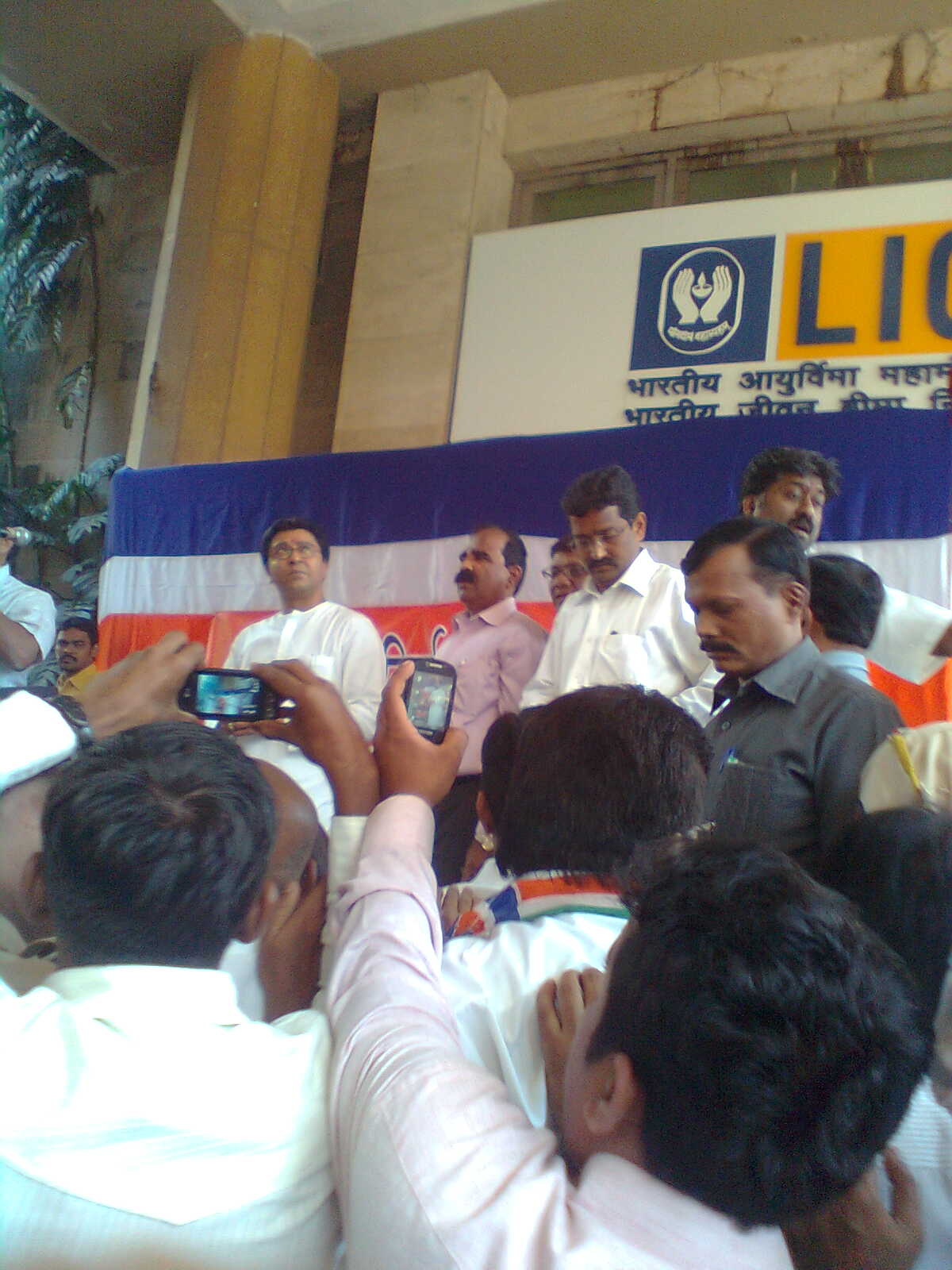
ZEE 24 HRS - MEDIA COVERAGE - MAHARASHTRA NAVNIRMAN JANADHIKARSENA
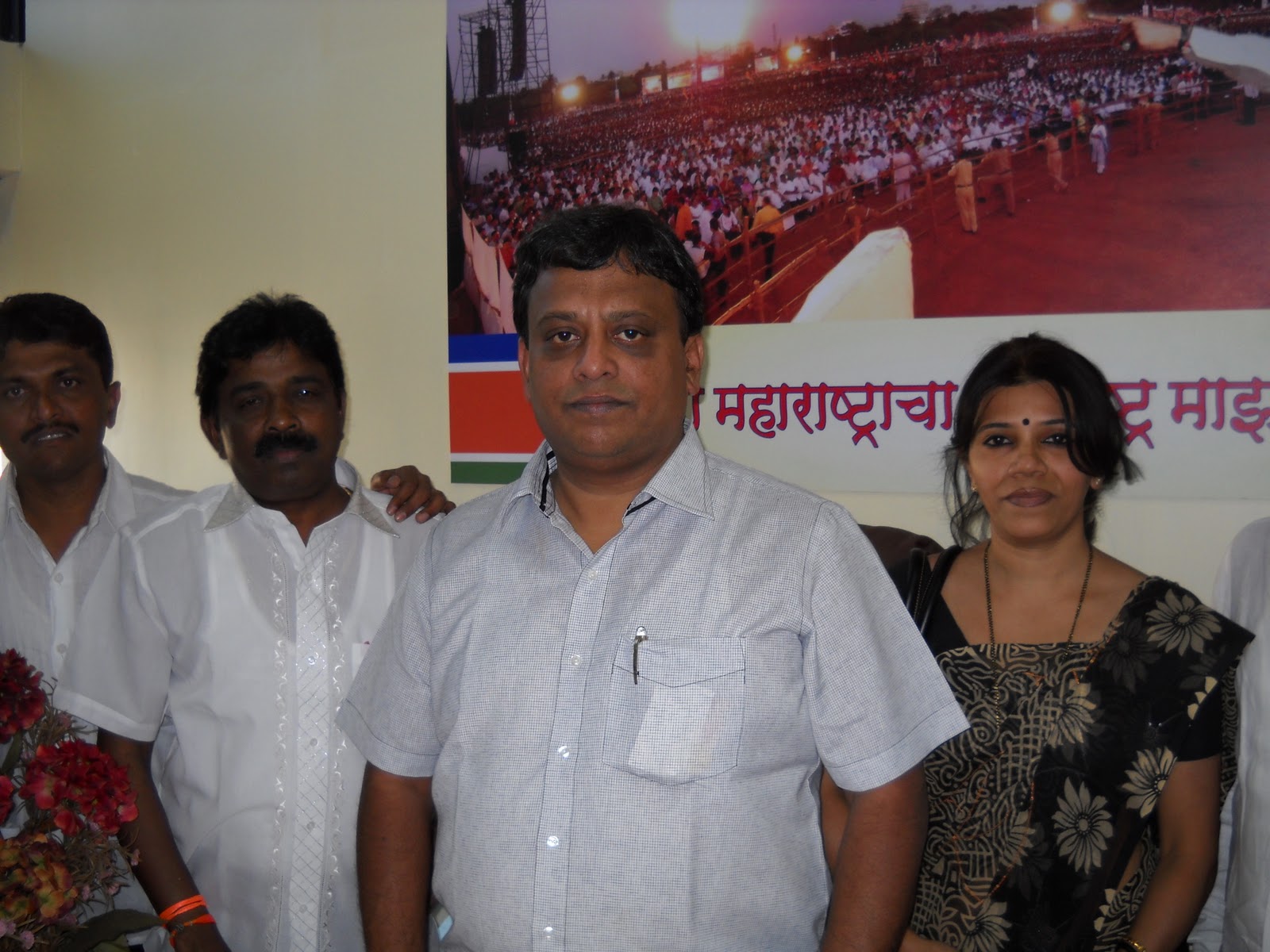
INAUGURATION OF OFFICE OF MAHARASHTRA NAVNIRMAN JANADHIKARSENA AT LIC NEW YOGKSHEMA OFFICE OF MAHARASHTRA NAVNIRMAN JANADHIKARSENA AT LIC NEW YOGKSHEMA CHURGATE INAUGURATED BY RAJ SAHEB THAKARE CHIEF OF MNS
1ST NEW YEAR POCKET CALENDER OF "TAPAL VIBHAG JANADHIKARSENA" IS ALSO ANUGURATED BY HON. RAJSAHEB THAKARE
Tuesday, December 21, 2010
INAUGURATION OF OFFICE OF MAHARASHTRA NAVNIRMAN JANADHIKARSENA AT LIC NEW YOGKSHEMA
OFFICE OF MAHARASHTRA NAVNIRMAN JANADHIKARSENA AT LIC NEW YOGKSHEMA CHURGATE INAUGURATED BY RAJ SAHEB THAKARE CHIEF OF MNS
1ST NEW YEAR POCKET CALENDER OF "TAPAL VIBHAG JANADHIKARSENA" IS ALSO ANUGURATED BY HON. RAJSAHEB THAKARE
Tuesday, December 14, 2010
Monday, December 13, 2010
Saturday, December 11, 2010
Wednesday, December 8, 2010
Tuesday, November 30, 2010
Revision of Fixed Monetary compensation (FMC) to delivery staff and remuneration to other staff
File No. 10-7/2001-P.E.II
Government of India
Ministry of Communications & IT
Department of Posts
(Establishment Division)
Dak Bhawan Sansad Marg New Delhi – 110001
Dated the 24-11-2010
Chief Postmaster General
Postmaster General
General Managers (Finance)
Director of Accounts Postal
Subject: - Revision of Fixed Monetary compensation (FMC) to delivery staff and remuneration to other staff
Sir/Madam,
I am directed to refer to Directorates letter of even number dated 4-9-2002 and 28.1.2003 on the above subject.
2. The Department has received a number of references from the staff Associations requesting for upward revision of fixed Monetary compensation (FMC) admissible to Postmen staff. A Committee of Senior Officers was constituted for looking into the issue and the report of the Committee has been examined carefully in consultation with integrated Finance wing and the Competent Authority has ordered enhancement of the Fixed Monetary compensation (FMC) admissible to Postmen staff. The details are as under:
- When One Postman performs duty of an absentee Postman by combination of duties from Rs.29 per day revised to Rs.50 per day
- When two Postmen perform duty of an absentee Postman by sharing the beat from Rs.14 per day revised to Rs.24 per day
3. The competent Authority has also ordered fixation/revision of Holiday Monetary Compensation payable to Postmen Staff and other Departmental staff brought on duty on 2nd consecutive Holiday if three consecutive holidays occur as shown under:
Remuneration to
- for Supervisor Rs.85 per holiday for 4 hours
- for Postal Assistant Rs.85 per holiday for 4 hours
- for Postmen/Sorting Postmen Rs.85 per holiday
- for Multi tasking staff Rs.60 per holiday for 4 hours
4. All other conditions for payment of Fixed Monetary compensation (FMC) issued vide OM No.10-23/87-PE.I dt. 21.12.93 and delivery of Unregistered letters on holidays issued under 9-25/92-CI dt. 10.9.92 will remain unchanged.
5. The Expenditure on account of revision has to be met from the allocated funds of the units under the prescribed Head of account.
6. These orders will take effect from the date of issue.
7. This issues in concurrence with the Integrated Finance Wing vide their diary number 286/FA/10/CS dated 24.11.2010.
Sd/-
(K. Rameswara Rao)
Asst. Director General (Estt)
All India Consumer Price Index Numbers for Industrial Workerson Base 2001=100 for the Month of October, 2010
All India Consumer Price Index Number for Industrial Workers (CPI-IW) on base 2001=100 for the month of October, 2010 increased by 2 points and stood at 181 (one hundred and eightyone).
During October, 2010, the index recorded an increase of 11 points in Kodarma centre, 7 points in Giridih centre, 6 points in Mercara centre, 5 points each in Bhilwara and Ghaziabad centres, 4 points each in 4 centres, 3 points in 4 centres, 2 points in 12 centres and 1 point in 32 centres. The index decreased by 2 points in Ludhiana centre, 1 point in 3 centres, while in the remaining 17 centres the index remained stationary.
The maximum increase of 11 points in Kodarma centre is mainly on account of increase in the prices of Rice, Wheat, Fish Fresh, Milk, Onion, Garlic, Vegetable & Fruit items, etc. The increase of 7 points in Giridih centre is due to increase in the prices of Rice, Wheat Atta, Milk, Onion, Vegetable items, etc. The increase of 6 points in Mercara centre is due to increase in the prices of Rice, Goat Meat, Onion, Garlic, Vegetable items, Firewood, etc. The increase of 5 points in Bhilwara centre is due to increase in the prices of Rice, Goat Meat, Milk, Onion, Tea (Readymade), Firewood, Auto Rickshaw Charges, etc. and in case of Ghaziabad centre it is due to increase in the prices of Rice, Wheat Atta, Vegetable items, Tailoring Charges, etc. However, the decrease of 2 points in Ludhiana centre is due to decrease in the prices of Wheat Atta, Arhar Dal, Masur Dal, Moong Dal, Vegetable & Fruit items etc.
The indices in respect of the six major centres are as follows:
Ahmedabad =178 Delhi = 168 Bangalore = 184 Kolkata =177
Chennai = 162 Mumbai = 181
The point to point rate of inflation for the month of October, 2010 is 9.70% as compared to 9.82% in September, 2010.
Wednesday, November 24, 2010
Redesignating Group'D' as Multi Tasking Staff Group 'C'
In pursuance to Ministry of Personnel, Public Grievances and Pension Department of Personnel & Training O.M. No.AB-14017 / 6/ 2009 - Estt (RR) dated 30th April 2010 and O.M. No.1-20/2008-PCC dated 24th Sept 2010 of Department of Posts the designation of erstwhile Central Secretariat Group 'D' employees will be designated as Multi Tasking Staff Group 'C' in the Secretariat
Monday, November 22, 2010
ORDERS IN RESPECT OF POSTMASTER CADRE ISSUED
Government of India
Ministry of Communications & IT
Department of Posts
Dak Bhawan, Sansad Marg
New Delhi – 110001
Dated, 22nd November, 2010
Sub: - Introduction of Postmaster Cadre in Postal Wing.
Sir/Madam,
I am directed to say that Department of Posts operates mainly through its about 25500 Departmental Post Offices. The services it offers have grown in the traditional areas of sale of stamps, booking of Money orders and Registered letters as also in Savings Bank functions, especially where Post Offices disburse NREGA wages to beneficiaries. In many post offices these activities are carried out electronically, new services like e-payment, e-post etc is also offered. Further the Department has also entered into agreements with private players like Western Union for money transfers. In the area of mail, both express, parcel and traditional, the Department of Posts faces tremendous competition. It has to offer excellent services by way of continuous upgrades in quality and in the add on value of its mail products, like IOD, national billing, same day delivery of corporate mail etc.
2. In spite of the long existence of the Post Offices and challenges being faced by the Department from private players in the field there had never been an exclusive cadre for Postmasters. The Postal Assistants, LSG/HSG-II, I etc. are posted to man the posts of Postmasters. This system served the Department quite well till some time back. But now in order to improve/upgrade the functioning of the Post Offices, meet the present day requirement of specialization in Postal office management in the wake of introduction of technology, challenges from market and to increase productivity it has absolutely become essential to ensure that key Post Offices are headed by professional managers. Thus, in order to ensure that professionally qualified, trained and meritorious officials head they key Post Offices, it has been decided to introduce a separate cadre of Postmasters comprising the following grades by carving out the posts from existing General Line posts as ordered vide this Directorates letter No. 13-2/2010-PE-I dt. 03.02.2010.
- Senior Postmaster 116 Posts (Rs. 9300-34800 + Rs.4800 Grade Pay)
- Postmaster Gr – III 495 Posts (Rs.9300-34800 + Rs.4600 Gr. Pay)
- Postmaster Gr-II 511 Posts (Rs. 9300-34800 + Rs.4200 Gr. Pay)
- Postmaster Gr-I 2097 Posts (Rs. 5200-20200 + Rs.2800 Gr. Pay)
3. The Recruitment Rules of the above stated grades have since been framed and notified. A copy of the Recruitment Rules called the Department of Posts, Senior Postmaster (Group B Gazetted), Postmaster (Grade ‘ III and II’ – Group B non – Gazetted) and Postmaster (Grade I-Group C non-Gazetted) Recruitment Rules, 2010, dated 9th September, 2010 is forwarded herewith.
4. The number of posts in the various grades of the Postmaster carved out of the existing General Line Posts in various Postal Circles is being issued separately.
5. Thus it may be noted that:
I. A separate cadre of Postmasters has been created at the level of LSG, HSG-II, HSG-I and PS Group ‘B’ by carving out the cadre from the existing General Line Cadre Posts in Postal Wing and PS Group ‘B’ and designated as Postmaster Gr –I, Postmaster Gr.II , Postmaster Gr.III and Senior Postmaster.
II. Initial constitution of the various Grades of Postmasters shall be done by inviting options/applications from the existing incumbents of LSG, HSG-II, HSG-I in Post offices and PS Group, ‘B’.
III. In subsequent years all the vacancies in Postmaster Gr.I shall be filled up through a Limited Departmental Competitive Examination, From amongst PAs with 5 years regular service in the grade.
IV. All the vacancies in Postmaster Gr. II Posts shall be filled up by promotion from amongst Postmaster Gr. I with 6 years regular service in the grade (including regular service in LSG, if any).
V. All the vacancies in Postmaster Gr. III posts shall be filled up by promotion from amongst Postmaster Gr. II with 5 years regular service the grade (including regular service in HSG II, If any).
VI. 25% of vacancies in the grade of Sr. Postmaster will be filled up by promotion of Postmaster Gr. III with 2 years of regular service in the grade (including regular service in HSG, I if any) and 75% by Inspector of Posts (IPOs) with 6 years of regular service in the grade on the basis of Limited Departmental Competitive Examination (LDCE).
VII. The officials in PS Gr ‘B’ and Senior Postmaster (Gazetted) would be eligible for induction in IPOs, Gr ‘A’ on the basis of a consolidated eligibility list.
6. To begin with the Postal Circles, as per the provisions of the Recruitment Rules, may call for the options/applications with their bio-data from the willing officials holding the posts in the equivalent grades for appointment as Postmaster grade I, II and III respectively. While inviting for the applications it may be categorically stated that:
Once and official submits his application he will not be allowed to withdraw the same.
Officials who are still left with at least two years of service to retire may only apply in order to avoid their dislocation at the fag end of their service.
In the event of their appointment as Postmaster their further career progression will be in the hierarchy in the Postmaster cadre only as per the provisions in the relevant Recruitment Rules and not in the General Line.
7. The applications so received may be scrutinized to find out the eligibility of the applicants. Thereafter the applications of the eligible applicants may be placed before the Screening Committee mentioned under Col. 11 of the respective grades for assessing their suitability based on their ACRs and vigilance clearance provided they attain the minimum bench mark of ‘Good’ Those who are found suitable they may be arranged in the order of seniority for appointment in respective grade of postmaster as they enjoyed in the General Line.
8. If after filling up the posts as per procedure mentioned in above paragraph certain number of posts still remain unfilled the same shall be filled up by promotion as per the provision contained in col. 12 of the respective Recruitment Rules. It may please be noted that in that event the unfilled posts in Postmaster Gr. I will have to be filled up on the basis of Limited Departmental Competitive Examination. The pattern and scheme for Limited Departmental Competitive Examination to fill up the vacancies in the grade of Postmaster Gr.I would follow shortly.
9. All the Postal circles are requested to follow the time-line mentioned below to fill up the posts of Postmaster:
(i) Date of Issue of Circular calling for the options/applications for appointment as Postmaster Grade I, II and III. - 14.12.2010
(ii) Last date for receipt of options/applications along with bio-data - 15.01.2011
(iii) Completion of scrutiny of applications and obtaining Vigilance Clearance and ACR dossiers. - 31.01.2011
(iv) Submission to Screening Committee. - 10.02.2011
(vi) Submission of the minutes to the appointing authority for approval - 01.03.2011
(vii) Issue of appointment orders - 16.03.2011
10. Thereafter the Postmasters so appointed may be deputed for training immediately in consultation with the Training Division of the Directorate.
11. The receipt of the letter may please be acknowledged.
Yours faithfully,
Sd/-
(V. C. Kajla)
Director (SPN)
Tel. No. 23096092
Wednesday, November 17, 2010
Tuesday, November 16, 2010
Opening of Post Offices
The existing number of Post Offices in urban and rural areas of the country is 15,797 and 1, 39,182 respectively as on 31.03.2010. Opening of Post offices in Rural and urban areas of the country is an ongoing exercise and these are opened subject to fulfilment of prescribed norms. In view of the poor socio-economic conditions prevalent in rural areas, there are liberalized population and financial norms for opening of Post offices there. During the current financial year 2010-11, target for opening of 200 Branch Post Offices (BOs) and 110 Sub Post Offices (SOs) has already been issued to Circles.
Rural areas are served by regular Departmental Post Offices manned by regular Departmental employees and Extra Departmental Post Offices manned by part time Gram Dak Sevaks. Departmental employees are paid regular salary as being paid to the Central Government employees, while Gramin Dak Sevaks who work on a part time basis, are paid Time Related Continuity Allowance (TRCA) on a pro-rate basis and normal Dearness Allowance. The Gramin Dak Sevaks are not paid regular salary at par with Central Government employees as they are outside the regular civil service.
Monday, November 8, 2010
Sunday, November 7, 2010
Thursday, November 4, 2010
Protection of Women against Sexual Harassment at Workplace Bill, 2010
The Union Cabinet today approved the introduction of the Protection of Women against Sexual Harassment at Workplace Bill, 2010 in the Parliament to ensure a safe environment for women at work places, both in public and private sectors whether organised or unorganized. The measure will help in achieving gender empowerment and equality.
The proposed Bill, if enacted, will ensure that women are protected against sexual harassment at all the work places, be it in public or private. This will contribute to realisation of their right to gender equality, life and liberty and equality in working conditions everywhere. The sense of security at the workplace will improve women's participation in work, resulting in their economic empowerment and inclusive growth.
Salient features of the Bill are as follows:
- The Bill proposes a definition of sexual harassment, which is as laid down by the Hon'ble Supreme Court in Vishaka v. State of Rajasthan (1997). Additionally it recognises the promise or threat to a woman's employment prospects or creation of hostile work environment as 'sexual harassment' at workplace and expressly seeks to prohibit such acts.
- The Bill provides protection not only to women who are employed but also to any woman who enters the workplace as a client, customer, apprentice, and daily wageworker or in ad-hoc capacity. Students, research scholars in colleges/university and patients in hospitals have also been covered. Further, the Bill seeks to cover workplaces in the unorganised sectors.
- The Bill provides for an effective complaints and redressal mechanism. Under the proposed Bill, every employer is required to constitute an Internal Complaints Committee. Since a large number of the establishments (41.2 million out of 41.83 million as per Economic Census, 2005) in our country have less than 10 workers for whom it may not be feasible to set up an Internal Complaints Committee (ICC), the Bill provides for setting up of Local Complaints Committee (LCC) to be constituted by the designated District Officer at the district or sub-district levels, depending upon the need. This twin mechanism would ensure that women in any workplace, irrespective of its size or nature, have access to a redressal mechanism. The LCCs will enquire into the complaints of sexual harassment and recommend action to the employer or District Officer.
- Employers who fail to comply with the provisions of the proposed Bill will be punishable with a fine which may extend to ` 50,000.
- Since there is a possibility that during the pendency of the enquiry the woman may be subject to threat and aggression, she has been given the option to seek interim relief in the form of transfer either of her own or the respondent or seek leave from work.
- The Complaint Committees are required to complete the enquiry within 90 days and a period of 60 days has been given to the employer/District Officer for implementation of the recommendations of the Committee.
- The Bill provides for safeguards in case of false or malicious complaint of sexual harassment. However, mere inability to substantiate the complaint or provide adequate proof would not make the complainant liable for punishment.
Implementation of the Bill will be the responsibility of the Central Government in case of its own undertakings/establishments and of the State Governments in respect of every workplace established, owned, controlled or wholly or substantially financed by it as well as of private sector establishments falling within their territory. Besides, the State and Central Governments will oversee implementation as the proposed Bill casts a duty on the Employers to include a Report on the number of cases filed and disposed of in their Annual Report. Organizations, which do not prepare Annual Reports, would forward this information to the District Officer.
Through this implementation mechanism, every employer has the primary duty to implement the provisions of law within his/her establishment while the State and Central Governments have been made responsible for overseeing and ensuring overall implementation of the law. The Governments will also be responsible for maintaining data on the implementation of the Law. In this manner, the proposed Bill will create an elaborate system of reporting and checks and balances, which will result in effective implementation of the Law.
Friday, October 29, 2010
All India Consumer Price Index Number for Industrial Workers (CPI-IW) on base 2001=100 for the month of September, 2010 increased by 1 point and stood at 179 (one hundred and seventynine).
All India Consumer Price Index Numbers for Industrial Workers on Base 2001=100 for the Month of September, 2010
All India Consumer Price Index Number for Industrial Workers (CPI-IW) on base 2001=100 for the month of September, 2010 increased by 1 point and stood at 179 (one hundred and seventynine).
During September, 2010, the index recorded an increase of 6 points each in Darjeeling, Durgapur and Jalpaiguri centres, 5 points each in Siliguri and Delhi centres, 4 points each in Angul Talcher, Rajkot and Belgaum centres, 3 points in 12 centres, 2 points in 13 centres and 1 point in 24 centres. The index decreased by 3 points in Bhopal centre, 2 points in 4 centres and 1 point in 4 centres, while in the remaining 12 centres the index remained stationary.
The maximum increase of 6 points in Darjeeling, Durgapur and Jalpaiguri centres is mainly on account of increase in the prices of Rice, Wheat Atta, Vegetable items, Electricity Charges, etc. The increase of 5 points in Siliguri and Delhi centres is due to increase in the prices of Rice, Wheat, Wheat Atta, Onion, Vegetable items, etc. The increase of 4 points in Angul Talcher, Rajkot and Belgaum centres is due to increase in the prices of Rice, Wheat, Goat Meat, Onion, Vegetable items, Tea (Readymade), etc. However, the decrease of 3 points in Bhopal centre is due to decrease in the prices of Rice, Wheat, Goat Meat, Arhar Dal, Vegetable items, etc.
The indices in respect of the six major centres are as follows:
1. Ahmedabad – 176
2. Bangalore – 185
3. Chennai – 162
4. Delhi – 169
5. Kolkata – 176
6. Mumbai – 178
The point to point rate of inflation for the month of September, 2010 is 9.82% as compared to 9.88% in August, 2010.
All India Consumer Price Index Number for Industrial Workers (CPI-IW) on base 2001=100 for the month of September, 2010 increased by 1 point and stood at 179 (one hundred and seventynine).
During September, 2010, the index recorded an increase of 6 points each in Darjeeling, Durgapur and Jalpaiguri centres, 5 points each in Siliguri and Delhi centres, 4 points each in Angul Talcher, Rajkot and Belgaum centres, 3 points in 12 centres, 2 points in 13 centres and 1 point in 24 centres. The index decreased by 3 points in Bhopal centre, 2 points in 4 centres and 1 point in 4 centres, while in the remaining 12 centres the index remained stationary.
The maximum increase of 6 points in Darjeeling, Durgapur and Jalpaiguri centres is mainly on account of increase in the prices of Rice, Wheat Atta, Vegetable items, Electricity Charges, etc. The increase of 5 points in Siliguri and Delhi centres is due to increase in the prices of Rice, Wheat, Wheat Atta, Onion, Vegetable items, etc. The increase of 4 points in Angul Talcher, Rajkot and Belgaum centres is due to increase in the prices of Rice, Wheat, Goat Meat, Onion, Vegetable items, Tea (Readymade), etc. However, the decrease of 3 points in Bhopal centre is due to decrease in the prices of Rice, Wheat, Goat Meat, Arhar Dal, Vegetable items, etc.
The indices in respect of the six major centres are as follows:
1. Ahmedabad – 176
2. Bangalore – 185
3. Chennai – 162
4. Delhi – 169
5. Kolkata – 176
6. Mumbai – 178
The point to point rate of inflation for the month of September, 2010 is 9.82% as compared to 9.88% in August, 2010.
Sunday, October 17, 2010
Wednesday, October 13, 2010
Thursday, October 7, 2010
Wednesday, September 29, 2010
SOME DEVEPLOMENT : PL BONUS
PL BONUS TO POSTAL EMPLOYEES IS BEING DECLARED AS 60 DAYS AS DECIDED ON LAST YEAR FORMULA MAXIMUXM AMOUNT WILL BE RS 6908/-
Tuesday, September 28, 2010
Monday, September 27, 2010
Postal Scam involving Rs. 2.56 crore - CBI has arrested two accused
The Central Bureau of Investigation has arrested two accused (private persons) in a scam of Rs 2.56 crores relating to the senior citizen saving scheme (SCSS) accounts at a post office in Vadodara (Gujarat).
A case was registered on 18.9.2010 against four Officials of Chemical industries Sub Post Office, Vadodara; an authorized postal agent; two private persons and others under sections 120B, 420,467,468,471 IPC and 13(2) r/w 13(1) (d) of the Prevention of Corruption Act, 1988.
It was alleged that the accused private persons in connivance with the accused Officials of sub post office reactivated 58 Senior Citizen Saving Scheme (SCSS) accounts, which were already closed and the credits of the amount were shown in these accounts in the computer of the post office. About 8 savings accounts were opened in the name of accused, their relatives and friends in the same post office The balance shown against these SCSS accounts was withdrawn. The amounts withdrawn from the SCSS accounts were deposited in the newly opened saving accounts in cash on the same day to prevent detection of cash flow variation by the Head Post Office. The accused, subsequently withdrew the amount from saving accounts by issuing cheques routed through clearing house. Thus, the accused have caused loss to the Government of India to the tune of Rs. 2.56 crores (approx) by withdrawing the amount against the closed SCSS accounts.
Searches were conducted at the residential/office premises of accused persons at eight places and documents related to investments by one of the accused to the tune of Rs. 47 lakhs (approx) were recovered.
Both the arrested accused were produced in the Designated Court at Gandhinagar and remanded to CBI custody up to 28.09.2010.
Further investigation is continuing
Tuesday, September 21, 2010
Subscribe to:
Posts (Atom)